


Brock Murray
Published content

expert panel
Sep 25, 2026
The first generation of AI adoption asked a simple question: What work can we automate?The next question is harder: What happens to the people who were experts at doing it before?Expertise has traditionally been built through practice. Engineers write and review code. Analysts work through problems. Marketers study audiences and campaigns. Architects design systems. Leaders accumulate judgment by making decisions and seeing what happens next. If AI increasingly performs those activities, where does that leave the role of the expert?Members of the Senior Executive AI Think Tank—a curated group of leaders specializing in machine learning, generative AI and enterprise AI applications—are thinking about that transition from inside the organizations and disciplines being reshaped by AI. Together, they raise an important question that reaches into the design of the organization itself: How do you build a company where AI can do more of the work without losing the human expertise that tells the company what work is worth doing?
expert panel
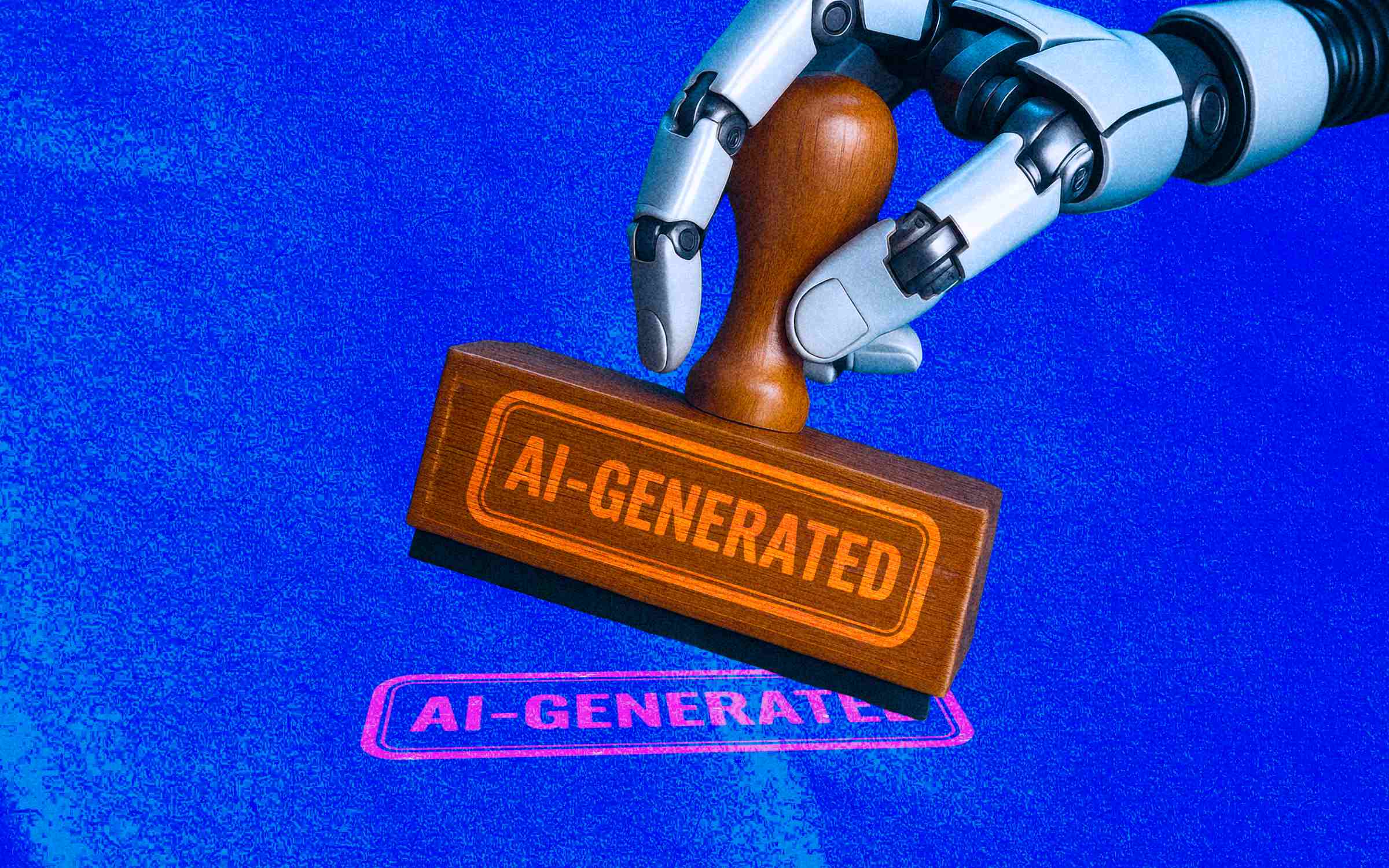
Anthropic’s decision to add invisible watermarks to Claude-generated text has brought a long-running AI debate into sharper focus: How should businesses establish the origin of AI-assisted content, and what should they do with that information once they have it?The question matters as generative AI becomes embedded in everyday knowledge work, from drafting and research to marketing, analysis and customer communications. The European Union’s AI Act is also pushing the industry toward machine-readable disclosure of AI-generated content, making provenance an increasingly important part of enterprise AI strategy.But provenance is not the same as authorship, quality or accountability. A watermark may establish that an AI system was involved without explaining how extensively it was used, what a human changed or who ultimately stands behind the work.Members of the Senior Executive AI Think Tank, a curated group of experts specializing in machine learning, generative AI and enterprise AI applications, offer a range of perspectives on what should come next. In the discussion that follows, they examine whether provenance should be standard or optional, where watermarking fits, how companies can protect privacy and human judgment, and what AI leaders should do to build greater trust and accountability around AI-generated content.

expert panel
Jul 23, 2026
In AI, success is no longer determined solely by selecting the largest language model or achieving the highest benchmark score. Increasingly, organizations are deploying AI systems composed of multiple foundation models, retrieval systems, APIs, business applications and autonomous agents working together to complete complex tasks.As these systems become more autonomous, reliability becomes a systems engineering challenge rather than simply a model evaluation problem. According to the National Institute of Standards and Technology's AI Risk Management Framework, trustworthy AI requires organizations to continuously monitor, govern and manage risks throughout the lifecycle—not simply evaluate a model before deployment. Those principles become even more important as organizations adopt agentic AI capable of making decisions and invoking external tools.Members of the Senior Executive AI Think Tank, with expertise in machine learning, generative AI, and enterprise AI applications, believe orchestration is rapidly becoming the operational foundation that makes this possible. Rather than simply routing requests between models, orchestration determines how systems select models, validate outputs, monitor execution, recover from failures and balance competing priorities including latency, quality, security and cost.In the following sections, they explore the critical decisions leaders must make as AI systems become more autonomous—from improving routing and evaluation to strengthening observability, managing complexity and creating safeguards that allow organizations to scale AI with confidence.

expert panel
AI observability is quickly becoming one of the most consequential shifts in enterprise AI—not because it adds more dashboards, but because it exposes how AI systems actually behave inside real business workflows. For executives, that visibility is both a breakthrough and a burden. It reveals model performance, data quality, user interaction patterns and system drift in real time, yet it often arrives in a form that is fragmented, technical and difficult to translate into decisions that matter at the board level.Organizations are rapidly scaling generative AI and machine learning systems across core operations, but many are struggling to operationalize oversight in a way that connects technical signals to measurable business outcomes. The result is a widening gap between AI capability and executive clarity—where systems are increasingly powerful, but not always understandable in business terms.Members of the Senior Executive AI Think Tank—a curated group of leaders in machine learning, generative AI and enterprise transformation—argue that the issue is not a lack of data. It is a lack of translation. AI observability, they note, only becomes strategically meaningful when organizations move beyond monitoring and toward decision-making frameworks that connect model behavior, risk signals and user impact directly to business KPIs.In the sections that follow, Think Tank members break down how organizations can close this gap in practice—from building operating models that turn observability into action, to identifying behavioral drift before it becomes business risk, to redefining governance so insights don’t remain trapped in technical teams. They also surface the most persistent obstacles executives face today—including signal overload, fragmented ownership and the absence of shared language between business and technical stakeholders—and offer concrete ways leaders can turn visibility into decisions that drive measurable value.

expert panel
As organizations race to develop generative engine optimization (GEO) strategies, many are approaching AI visibility the same way they approached search engine optimization over the last two decades: Publish more content, optimize keywords and try to improve rankings. Yet the rise of generative AI is changing how information is discovered, evaluated and surfaced.Members of the Senior Executive AI Think Tank—a curated group of executives, technologists, AI practitioners and digital transformation leaders—argue that many organizations are operating under flawed assumptions about how generative systems work. Their collective message is strikingly consistent: AI visibility is less about gaming algorithms and more about establishing trust, authority and credibility across the digital ecosystem.According to a 2024 Gartner forecast on generative AI and search, traditional search traffic is expected to decline significantly as users increasingly rely on AI assistants and conversational interfaces to find information. As AI-generated responses become a primary gateway to information, organizations must rethink how they establish authority online.The experts below explain why many GEO assumptions are misguided and where leaders should focus their efforts instead.