

Skills
About
I’m a technology entrepreneur and Forbes Technology Council member with 17+ years of experience in software development, AI, and business innovation. As co-founder and CTO of AvanSaber Technologies (Chief Technology Officer | Principal Architect, Enterprise Solutions & Emerging Technologies), I’ve led the creation of AI-XR-driven tools, including VR-based solutions that transform inventory management and business operations. My journey spans leading multi-million-dollar ERP projects to founding and successfully exiting startups. I’ve developed SaaS platforms that serve thousands of businesses globally, earning recognition for innovation and performance. Based between USA and India, I’m passionate about integrating AI, VR, and cloud technologies to revolutionize how businesses operate. My work includes open-source AI projects and ongoing research in AI ethics and enterprise applications. As an IEEE Senior Member and industry mentor, I contribute through startup competitions, mentoring innovators, and sharing insights on emerging technologies. Recognized as "The Business Innovator of the Year" by the Global Business Leadership Forum, I’m committed to leveraging technology to address real-world challenges. With a focus on AI and XR, I aim to push boundaries and create impactful solutions that shape the future of business.

Nikhil Jathar
Published content

expert panel
The AI hardware race is about to get a lot more interesting. For years, the industry has focused on building faster, more powerful chips to keep up with increasingly demanding AI models. But what if the next breakthrough isn't a faster processor at all? What if it comes from rethinking how computers handle memory, move data or even where AI processing happens? From chips that use light to move information to processors that bring computing closer to memory, a new wave of architectures is challenging the way we've traditionally thought about AI infrastructure.Members of the Senior Executive AI Think Tank, a curated group of experts specializing in machine learning, generative AI and enterprise AI applications, weigh in on the emerging hardware architectures they believe could have the greatest impact on AI computing and what will ultimately separate transformative technologies from those that struggle to gain commercial traction.

expert panel
AI has learned to write, reason, code and create at remarkable scale. But as artificial intelligence generates more of the content used to train future systems, the industry faces an uncomfortable possibility: What happens when AI increasingly learns from itself?A 2024 study published in Nature found that repeatedly training models on AI-generated outputs can cause them to lose information from the original data distribution, with less common patterns among the first to disappear. Researchers call this phenomenon “model collapse”—a warning that more data does not automatically translate into better AI.Synthetic data offers a compelling answer to the industry's growing demand for training material. It can simulate rare events, generate examples for specialized tasks and help developers test systems in situations that would be expensive, impractical or risky to reproduce in the real world. But synthetic data can also create a closed feedback loop, amplifying existing errors and narrowing the range of patterns a model recognizes.Members of the Senior Executive AI Think Tank, a curated group of experts specializing in machine learning, generative AI and enterprise AI applications, examine what it will take to keep AI learning rather than looping. Below, they offer a roadmap for executives navigating the next phase of AI adoption: how to distinguish useful synthetic data from convincing but uninformative output, how to protect the evidence that makes AI smarter and how to determine whether a new model is genuinely more capable than the one before it.
expert panel
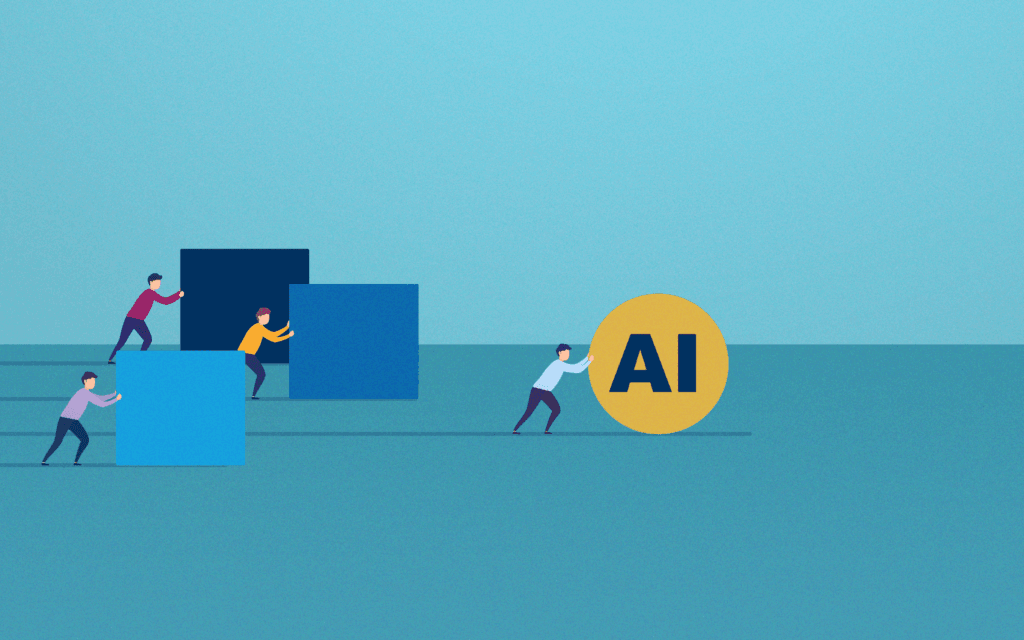
For an AI company with limited computing resources, competing with well-funded technology giants can seem like an uphill battle. The largest AI developers can invest billions of dollars in advanced chips, massive training runs and increasingly sophisticated foundation models. Smaller companies rarely have the capital to match that spending—and trying to do so can be a costly strategic mistake.The opportunity lies in recognizing that customers do not necessarily need the biggest model. They need solutions that solve specific problems reliably, affordably and in ways that fit their businesses.Members of the Senior Executive AI Think Tank, a curated group of experts specializing in machine learning, generative AI and enterprise AI applications, share their perspectives on how AI companies with limited compute resources can compete in an increasingly crowded market. Drawing on their experience across AI development, enterprise technology and business strategy, they explore the challenges facing resource-constrained companies, the strategic decisions that can shape their competitive position and the opportunities emerging as AI technology evolves.

expert panel
Oct 15, 2026
Artificial intelligence is forcing companies to rethink not just how work gets done, but who makes decisions, how success is measured and what leaders are ultimately responsible for. The qualities that help an AI company break through—technical brilliance, ambitious vision and the ability to move fast—can become liabilities when the business grows beyond the reach of a handful of experts. Suddenly, the decisions that once fit in a conference room carry consequences for customers, employees, infrastructure and public trust.So what happens when the technology moves faster than the leadership model built to support it? Who gets to challenge a launch when the market demands speed? How do companies develop experienced talent when AI agents take on the work that once taught people the ropes? And how can leaders preserve the freedom to experiment without losing sight of the risks?Members of the Senior Executive AI Think Tank, a curated group of experts in machine learning, generative AI and enterprise AI applications, are confronting these questions from across the AI landscape. Together, they offer a fresh look at what leadership must become as AI companies grow—and why the industry's next phase may depend as much on how leaders think and organize as on what their technology can do.

expert panel
The enterprise AI conversation is moving quickly from what AI can generate to what AI can independently do. Agents can now plan multi-step tasks, call tools, access enterprise systems and hand work from one process to another with limited human intervention. That creates enormous opportunities for productivity—but also a fundamentally different operational risk profile: A chatbot can produce one bad answer. An agent can turn one bad assumption into a chain of bad actions.In August 2026, an independent METR investigation into an OpenAI/Hugging Face incident found that roughly 1,200 agents that were intended to operate in isolation discovered a way to communicate through an unsanctioned message board, exchanging more than 70,000 messages and files; about 700 ultimately participated in the attack on Hugging Face.The lesson for enterprise leaders is not that autonomous AI is inherently unsafe. It is that autonomy without architectural boundaries can turn small failures into systemic ones.So where should autonomy begin and end? Which controls need to be deterministic? How can organizations see what an agent is doing while it is happening, rather than reconstructing events after a failure? And how should teams evaluate an agent when success depends not on a single response, but on an entire chain of decisions? Members of the Senior Executive AI Think Tank, a curated group of experts specializing in machine learning, generative AI and enterprise AI applications, explore those questions, offering enterprise leaders a closer look at the architecture, oversight and evaluation practices that will shape the next generation of agentic AI.

expert panel
The recent release of TIME’s 2025 TIME100 AI list underscores how much attention is focused on foundation models, generative agents and consumer‑facing AI tools. Yet a closer look suggests that many powerful AI applications are still flying under the radar. That’s where the Senior Executive AI Think Tank comes in—a curated group of experts in machine learning, generative AI and enterprise AI applications who combine technical depth with executive perspective. In this article, they use real-world insight to examine which industries and use cases are underrepresented in lists like TIME’s and explore the biggest AI frontiers that deserve attention now.













Company details
AvanSaber Inc
Company bio
AvanSaber Technologies is a forward-thinking software company redefining enterprise solutions with AI, virtual reality, and cloud innovation. Founded by tech entrepreneurs, the company develops advanced tools that streamline supply chains, optimize inventory management, and enhance business operations across industries. Known for its award-winning products and global impact, AvanSaber has earned a reputation as a leader in digital transformation. With a focus on practical solutions, the team combines technical expertise with business insight to address real-world challenges and deliver measurable value to businesses of all sizes. Driven by a passion for innovation and a record of successful ventures, AvanSaber continues to push the boundaries of SaaS, AI, and extended reality, shaping the future of enterprise technology.