

Skills
About
Pawan Anand is a senior technology executive and Portfolio Head at LTM, where he leads strategic AI-driven transformation for clients in the Communications, Media, and Entertainment (CME) sector. He oversees large-scale innovation programs spanning Generative AI, AgenticAI automation, and digital engineering, while managing high-impact global teams across industries. With deep expertise in Generative AI, Agile software engineering, and platform modernization, Pawan blends innovation with operational excellence. He holds an Executive Doctorate in Business Administration from Temple University, where his research explored how enterprises can integrate Generative AI into Agile software development at scale. A published thought leader and frequent speaker at global AI and digital transformation forums, Pawan is passionate about inclusive innovation, ethical AI, and mentoring future leaders. His contributions have earned recognition including Business Elite’s 40 Under 40 and the Globee Leadership Award.

Pawan Anand
Published content
expert panel
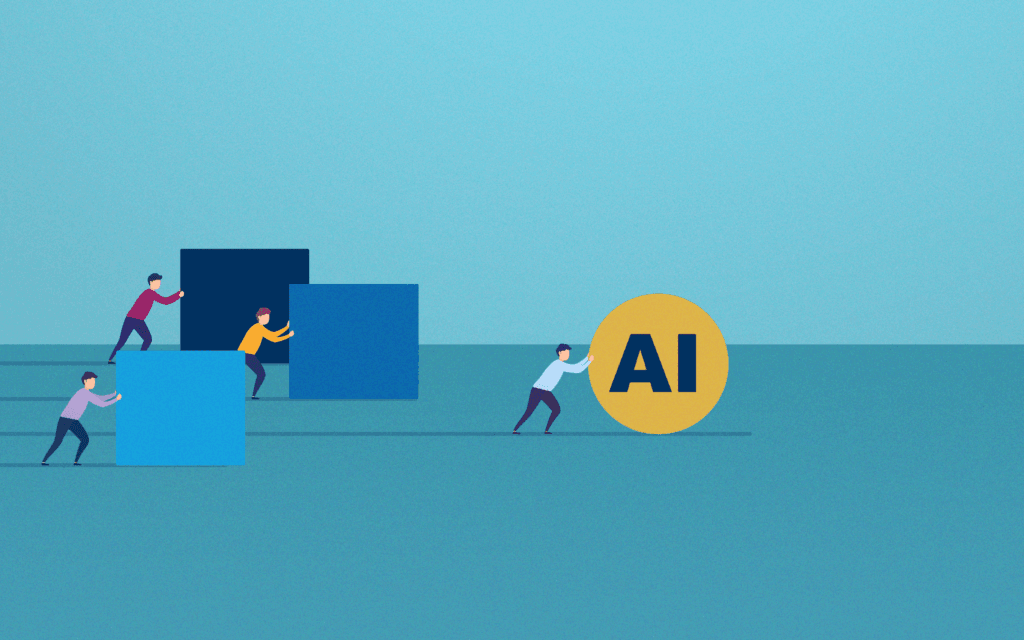
For an AI company with limited computing resources, competing with well-funded technology giants can seem like an uphill battle. The largest AI developers can invest billions of dollars in advanced chips, massive training runs and increasingly sophisticated foundation models. Smaller companies rarely have the capital to match that spending—and trying to do so can be a costly strategic mistake.The opportunity lies in recognizing that customers do not necessarily need the biggest model. They need solutions that solve specific problems reliably, affordably and in ways that fit their businesses.Members of the Senior Executive AI Think Tank, a curated group of experts specializing in machine learning, generative AI and enterprise AI applications, share their perspectives on how AI companies with limited compute resources can compete in an increasingly crowded market. Drawing on their experience across AI development, enterprise technology and business strategy, they explore the challenges facing resource-constrained companies, the strategic decisions that can shape their competitive position and the opportunities emerging as AI technology evolves.

expert panel
AI has a habit of making yesterday’s infrastructure decisions look permanent—until the next model, vendor or use case comes along. For enterprise leaders, that creates a difficult problem: AI is advancing faster than the infrastructure built to support it, while data platforms, security controls and governance programs can take years to design and implement.So what should companies make permanent, and what should they make easy to replace? We asked members of the Senior Executive AI Think Tank—a curated group of leaders specializing in machine learning, generative AI and enterprise AI applications—to explore how leaders can balance the needs of today with an AI landscape that is likely to look very different tomorrow.Below, they examine what belongs at the foundation of an AI-ready enterprise—and how leaders can build enough flexibility into that foundation to adapt without starting over every time the technology changes.

expert panel
Sep 25, 2026
The first generation of AI adoption asked a simple question: What work can we automate?The next question is harder: What happens to the people who were experts at doing it before?Expertise has traditionally been built through practice. Engineers write and review code. Analysts work through problems. Marketers study audiences and campaigns. Architects design systems. Leaders accumulate judgment by making decisions and seeing what happens next. If AI increasingly performs those activities, where does that leave the role of the expert?Members of the Senior Executive AI Think Tank—a curated group of leaders specializing in machine learning, generative AI and enterprise AI applications—are thinking about that transition from inside the organizations and disciplines being reshaped by AI. Together, they raise an important question that reaches into the design of the organization itself: How do you build a company where AI can do more of the work without losing the human expertise that tells the company what work is worth doing?

expert panel
The race to make AI indispensable in everyday life may have found its most compelling use case: health. As Google expands Gemini-powered health coaching capabilities and AI becomes increasingly embedded in wearables, smartphones and wellness platforms, the prospect of a 24/7 personalized health assistant is moving from science fiction to consumer reality.Members of the Senior Executive AI Think Tank believe AI health assistants possess characteristics few other AI applications can match: continuous engagement, highly personal relevance and the ability to influence daily behavior. Their optimism, however, comes with significant caveats.According to a Nature Digital Medicine analysis of large language models in healthcare, AI systems are advancing rapidly across clinical and consumer health applications, but researchers argue that stronger oversight, transparency and governance are necessary to ensure safe and responsible deployment.Think Tank members largely agree that AI health assistants have the potential to become the first truly mainstream consumer AI product, but they also emphasize that widespread adoption will depend on getting the safeguards right. Their insights reveal where the greatest opportunities lie, where the biggest risks remain and what organizations must do to build systems worthy of users' trust.
expert panel
Artificial intelligence remains one of the most consequential forces reshaping business, yet many organizations still struggle to distinguish meaningful breakthroughs from attention-grabbing headlines. While public discussion often centers on increasingly powerful models, digital assistants and speculation about artificial general intelligence, many enterprise leaders are discovering that the most transformative AI developments occur behind the scenes.Ask 10 AI experts what will matter most a year from now, and you might expect 10 different answers. Instead, members of the Senior Executive AI Think Tank—a curated group of experts specializing in machine learning, generative AI and enterprise AI applications—arrived at a strikingly similar conclusion: The biggest opportunities—and risks—aren't tied to the next model release. Across industries, they point to the infrastructure that makes AI useful in practice, from governance and security to evaluation, trust and workflow integration. At the same time, many are skeptical of some of today's loudest predictions, particularly around fully autonomous agents replacing human judgment at scale.As recent research from McKinsey suggests, organizations are increasingly finding that AI success depends less on access to cutting-edge models and more on the ability to operationalize them effectively. The experts featured here—those on the front lines of AI innovation—share the developments they believe leaders are underestimating, the trends they think are overhyped and where executives should be investing now to create lasting competitive advantage.
expert panel
As multimodal AI moves rapidly from novelty to baseline expectation, companies are confronting a deeper challenge than simply adding new features. Users increasingly expect software to understand text, voice, images and video simultaneously, while preserving context seamlessly across every interaction. That shift is forcing organizations to rethink how products are designed, architected and differentiated.Members of the Senior Executive AI Think Tank say the next era of product competition will center less on standalone AI capabilities and more on orchestration, workflow intelligence and trust. Their insights arrive as major technology companies race to integrate multimodal capabilities into mainstream applications. Multimodal systems capable of understanding and generating across formats are becoming foundational to enterprise software strategy. At the same time, organizations are discovering that simply embedding AI into existing workflows does not automatically create better user experiences.Instead, experts argue, multimodal AI is changing the very definition of interface design. Products are evolving from static tools into adaptive systems that anticipate intent, reduce friction and collaborate more naturally with users. The insights that follow explore why multimodal AI is forcing companies to rethink everything from UX design and workflow orchestration to trust, memory and product differentiation—and what leaders must do now to stay competitive.




Company details
LTM
Company bio
LTM - a Larsen & Toubro company - is an AI-centric global technology services company and the Business Creativity partner to the world’s largest enterprises. We bring human insights and intelligent systems together to help clients create greater value at the intersection of technology and domain expertise. Our capabilities span integrated operations, transformation, and business AI - enabling new ways of working, new productivity paradigms, and new roads to value. Together with over 87,000 employees across 40 countries and our global network of partners, LTM owns business outcomes for our clients, helping them not just outperform the market, but to Outcreate it.