

Skills
About
As Chief Executive Officer of INFORM North America, a leading provider of Artificial Intelligence (AI) for business operations that incorporates digital decision making, agile optimization and smart resource management across diverse industries, Justin Newell contributes extensive leadership and industry experience across multiple diverse industries and disciplines. His experience covers automotive vehicle logistics, automotive aftermarket, supply chain planning and logistics, inventory optimization, procurement, dealer operations, international project management, distribution center management, and operational systems/software solutions. Justin has more than 25 years of management, leadership, and business development experience, along with a broad range of software and operational process knowledge. He has been heavily involved in process optimization and change management throughout his career as well as employee recruitment and development, succession planning, and business continuity assurance. Justin’s core focus areas are employee growth, company culture, and maximizing employee retention to assure stability for future growth. He has played an integral role at INFORM North America, helping to deliver the company’s complex digital decision-making solutions to current and future partners, enabling their customers to achieve process efficiency, return on investment and industry growth. Justin’s in-depth supply chain knowledge is frequently tapped by leading media, industry associations and conference organizations seeking knowledgeable thought leaders who can provide real insights and practical strategies around digitalization and process optimization.

Justin Newell
Published content
expert panel
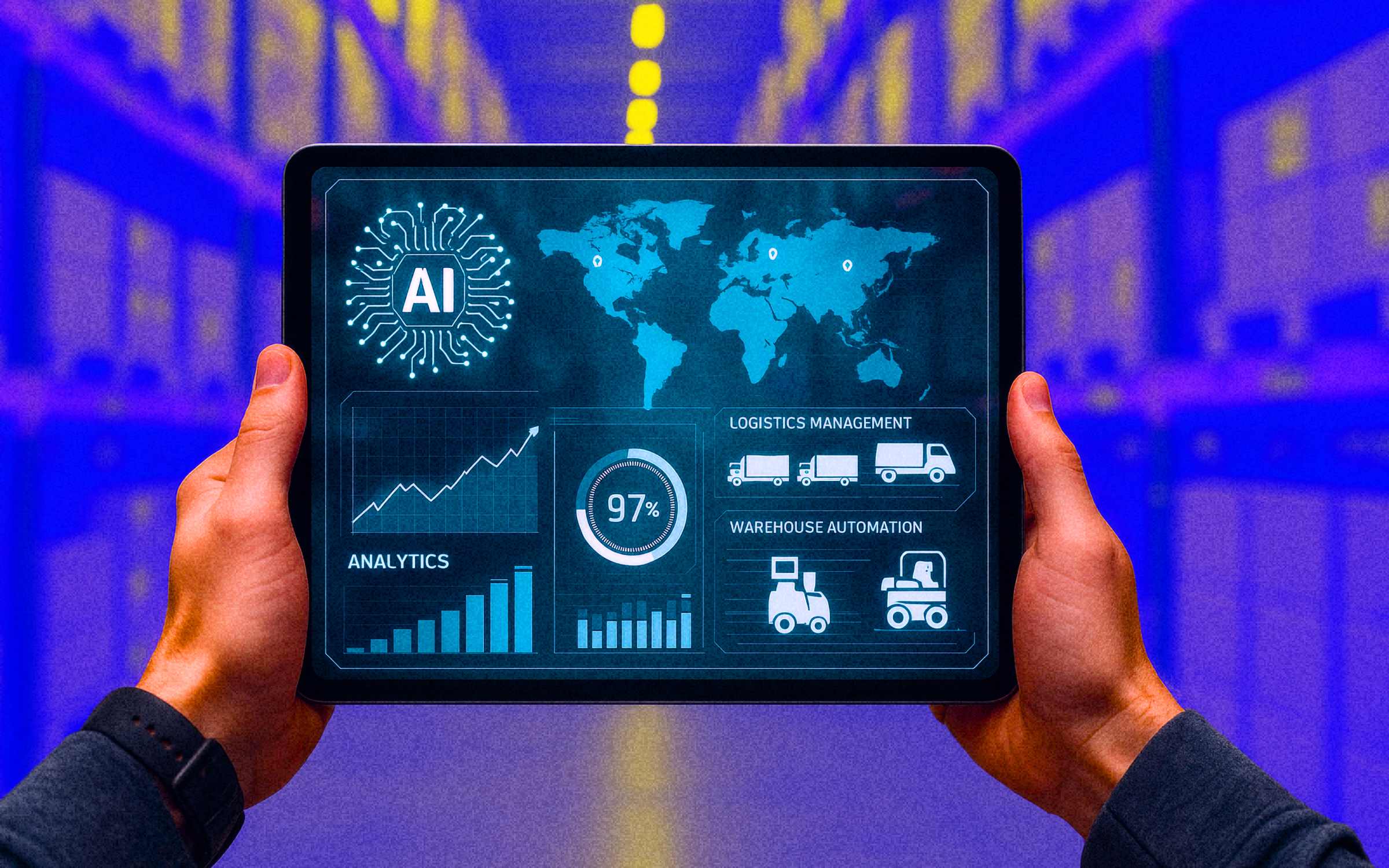
Supply chains have historically been designed around a simple premise: Build the best possible plan, then execute it as efficiently as possible. Artificial intelligence has made those plans smarter, helping companies forecast demand more accurately, optimize transportation routes and reduce inventory costs. But those improvements, while significant, still operate within the same playbook.The next chapter looks fundamentally different.Rather than simply making existing processes faster or cheaper, AI is beginning to reshape how supply chains are designed, managed and even governed. Emerging technologies such as agentic AI, digital twins and real-time decision engines can continuously evaluate changing market conditions, simulate alternative scenarios and recommend—or in some cases execute—responses before disruptions ripple across the business. In this model, supply chains become adaptive systems rather than static networks.The business case for that evolution is growing stronger. Gartner predicts that by 2030, half of supply chain management solutions will incorporate agentic AI capable of making autonomous cross-functional decisions, reflecting a broader shift from automation to intelligent orchestration. At the same time, geopolitical instability, changing trade policies and increasingly unpredictable customer demand are forcing organizations to rethink resilience as a competitive advantage—not just an operational objective.Against this backdrop, members of the Senior Executive AI Think Tank, a curated community of leaders specializing in machine learning, generative AI and enterprise AI applications, see a common theme emerging. The greatest transformation will not come from AI replacing planners or optimizing another workflow. Instead, they argue, AI is becoming the connective tissue that links procurement, manufacturing, logistics, finance and leadership into continuously learning decision systems. That shift promises to redefine not only how supply chains operate but also how organizations make decisions, assign accountability and create value in an increasingly uncertain world.

expert panel
Across industries, executives are investing aggressively in artificial intelligence. Yet despite billions spent on experimentation, relatively few organizations have turned AI pilots into scalable platforms that generate repeatable value. According to PwC’s Global CEO Survey, 56% of CEOs report they’ve seen neither revenue nor cost benefits from investments in AI—a signal that experimentation alone is not enough to create enterprise impact. Members of the Senior Executive AI Think Tank—a curated group of leaders specializing in enterprise AI, machine learning and digital transformation—say the problem is rarely technical. Instead, organizations struggle with leadership alignment, operating models, governance and cultural change. Below, their insights reveal a consistent theme: Scaling AI requires redesigning how companies operate—not simply deploying more technology.

expert panel
No longer confined to analytics dashboards and recommendation engines, AI systems are now initiating transactions, approving workflows, flagging anomalies and even orchestrating other software agents. With this sudden increase in autonomy, business leaders are left asking: Where should humans step back—and where must they stay firmly in control? According to a 2025 McKinsey survey on the state of AI, nearly nine out of 10 organizations now report using AI in at least one business function, yet most are still early in scaling these technologies and many lack robust governance and risk controls. As artificial intelligence advances from advisory tools to agentic systems capable of multi-step planning and execution, the leadership challenge shifts: defining not just what AI can do, but what it should do. Members of the Senior Executive AI Think Tank—a curated group of experts in machine learning, generative AI and enterprise-scale transformation—argue that the real issue isn’t capability but accountability. Across their industry expertise, they all converge on one theme: The boundary between human judgment and machine decision-making must be dynamic, evidence-based and anchored in responsibility. Here is how they recommend drawing—and redrawing—that line.

expert panel
The recent release of TIME’s 2025 TIME100 AI list underscores how much attention is focused on foundation models, generative agents and consumer‑facing AI tools. Yet a closer look suggests that many powerful AI applications are still flying under the radar. That’s where the Senior Executive AI Think Tank comes in—a curated group of experts in machine learning, generative AI and enterprise AI applications who combine technical depth with executive perspective. In this article, they use real-world insight to examine which industries and use cases are underrepresented in lists like TIME’s and explore the biggest AI frontiers that deserve attention now.

article
AI Think Tank members predict the future of business dashboards, where natural language, predictive analytics, and strategic recommendations replace static charts and siloed metrics.

article
AI agents and memory-enabled models promise enterprise transformation—capturing institutional knowledge, automating workflows and making context-rich decisions. But without robust oversight, they pose security, privacy and accountability risks. Members of the Senior Executive AI Think Tank share insights on the risks and rewards of agentic AI in business.



Company details
INFORM
Company bio
INFORM develops software to optimize business processes using artificial intelligence (AI) and advanced mathematics of Operations Research. Founded in 1969 and headquartered in Aachen, Germany, the company promotes sustainable value creation in various industries through optimized decision-making. Its solutions are tailored to specific industry requirements and help over 2,000 current customers worldwide to operate more resiliently and sustainably with greater success. INFORM's systems serve a range of industries including aviation, automotive, financial institutions, logistics, manufacturing, transportation, telecommunications, and wholesale. The company is committed to ethical AI practices, sustainable customer relations and is increasingly focusing on cloud-based solutions. www.inform-software.com