
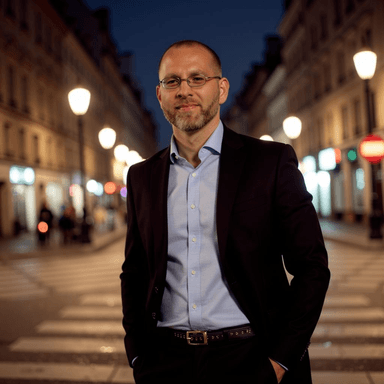
Jonathan H. Westover
Educator & Futurist; TopVoice in Leadership, HR, & Innovation; Founder & CEO, Human Capital Innovations; Co-Founder and Chief Workforce & Learning Officer, Future State University; Professor of Organizational Leadership and Change, Utah Valley UniversityFuture State University
Skills
About
Dr. Jonathan H. Westover is a best-selling and award-winning author and podcaster, a TopVoice in HR, Innovation, Leadership, Culture, Future of Work, Diversity and Inclusion, Change Management, and Education (Thinkers360), ranked Top 30 in Organizational Culture and Management (Global Gurus), in the Top 200 Biggest Voices in Leadership (LeadersHum), and ScholarGPS ranks him the #7 scholar in the world for job satisfaction research. Jonathan is an educational evangelist, a philanthropist, an angel investor, and an entrepreneur. He is founder and CEO of Human Capital Innovations and head researcher with the Nexus Institute for Work and AI, the host/producer of multiple shows on the HCI Podcast Network, Chief Academic and Learning Officer of the HCI Academy, and Managing Editor of the Human Capital Leadership Review. As an OD/HR/Leadership consultant, he has worked with organizations across the globe. Current Professional Roles Academic: Jonathan is Co-Founder and Chief Workforce & Learning Officer at Future State University, Professor of Organizational Leadership and Change at Utah Valley University, and Industry Impact Fellow in the Business Impact Lab. Additionally, he is a doctoral faculty at the University of Arizona (GC) and part of the Interdisciplinary Leadership Studies graduate program at Creighton University. Previously, he was Associate Dean and Director of HR undergrad and graduate academic programs at WGU and was UVU Chair of Organizational Leadership, Academic Director of the Center for Social Impact, Director of Academic Service-Learning in the Innovation Academy. Dr. Westover has been published widely in academic journals, books, and practitioner publications. At UVU he is also an affiliate faculty member in the MBA, MPA, and Integrated Studies programs and he has been a regular visiting faculty member in other international graduate business programs. Consulting: Jonathan is an experienced organizational leadership, people management, and organizational development consultant (Founder and CEO at Human Capital Innovations). For two decades, he has worked to help transform organizations across the globe. He is also the producer and host of the Human Capital Innovations (HCI) Podcast and Managing Editor of Human Capital Leadership Magazine. Previously, Jonathan was an external consultant with the firm Targeted Learning, and an internal consultant in the Human Resource Development office at Brigham Young University, in the corporate Organizational Development office at InterContinental Hotels, and in the corporate Organizational Development office at LG Electronics in Gumi, South Korea. Thought Leadership: Jonathan is a member of the Harvard Business Review Advisory Council, the Forbes Coaches Council, a Non-Resident Fellow in Social and Development Policy with the Nkafu Policy Institute (part of the Denis & Lenora Foretia Foundation), a member of the HR Certification Institute CEO Advisory Council and past member of the board of directors, member of the Humantelligence Scientific Advisory Board, Chair and Director of the Corporate Division of the Global Listening Centre, a CIPD Academic Fellow, and an Advance HE Senior Fellow. Jonathan has been published widely and quoted as a management expert in popular and professional media locally, nationally, and abroad (such as Forbes, The Economist, U.S. News and World Report, The Wall Street Journal, MSNBC, PBS, NBC, CBS, ABC, FOX, MarketWatch, HR.com, SHRM.org, HRCI.org, The Washington Post, and USA Today). Highlights of Past Academic and Professional Roles and Distinctions • President and Executive Board Member, Western Academy of Management (2023 - Present) • Visiting Academic at Harris Manchester College at the University of Oxford (2019) • Fulbright Scholar and AMINEF Senior Scholar at Atma Jaya Catholic University in Jakarta, Indonesia (2018) • Educational Development Visiting Fellow at the Centre for Teaching and Learning at the University of Windsor in Ontario, Canada (2018) • Learning Innovation Research Fellow at the Institute of Teaching and Learning Innovation at the University of Queensland in Brisbane, Australia (2017) • Visiting Scholar at the East-West Center in Washington (2017) • POSCO Fellow at the East-West Center in Honolulu, Hawaii (2016) • Visiting Scholar in the Kennan Institute at the Wilson Center in Washington, D.C. (2015) • Fulbright Scholar at Belarusian State University in Minsk, Belarus (2012) Education Jonathan received his Bachelor of Science degree in Sociology: Research and Analysis (with minors in management and Korean) from the College of Family, Home, and Social Sciences and his Master of Public Administration degree (emphases in Organizational Behavior and Human Resource Management) from the Marriott School of Management at Brigham Young University. He received his Ph.D. in Sociology (emphases in International Political Economy and Work and Organizations) from the College of Social and Behavioral Science at the University of Utah. He has also received graduate certificates in demography and higher education teaching from the University of Utah, as well as other certificates and specializations from universities like Harvard, Oxford, Cambridge, and more.

Jonathan H. Westover
Published content

expert panel
Solopreneurs can replace the accountability of a traditional workplace with measurable goals, outside support, regular reviews and systems designed to make commitments harder to ignore. Insights from members of the Senior Executive HR Think Tank show how independent professionals can stay focused without becoming their own worst boss.Working without a manager offers greater freedom, but it also removes many of the structures that make follow-through easier. No supervisor is checking deadlines, no colleague is flagging a missed commitment and no team meeting is prompting a progress update.That makes self-accountability less about having extraordinary discipline and more about deliberately building the structures that a workplace would normally provide. Members of the Senior Executive HR Think Tank bring perspectives spanning organizational psychology, leadership, recruiting, culture and career development to the question of how independent professionals can create those structures for themselves.Recent Gallup research reinforces the importance of the issue: In a survey, creating accountability ranked as the lowest-rated of seven leadership competencies, with just 46% of leaders rating themselves "exceptional or outstanding" at holding people responsible for exceptional performance. If accountability can be difficult even inside organizations with managers and teams, solopreneurs have even more reason to intentionally design it into their work.The experts suggest several ways to do that, from building a personal support network and creating financial consequences to making goals public, tracking measurable outcomes and protecting time for meaningful work.

expert panel
As AI takes on more recruiting tasks, HR leaders must decide where automation should stop, and human accountability should begin. Members of the Senior Executive HR Think Tank explain when candidates deserve human judgment, communication, transparency and a meaningful opportunity to challenge an automated decision.Hiring has always involved a tension between efficiency and humanity, but artificial intelligence is pushing that tension into new territory. AI can now help screen resumes, identify candidates, generate job descriptions and automate communication. According to LinkedIn's 2025 Future of Recruiting report, 37% of recruiting organizations are actively integrating or experimenting with generative AI, while 73% of talent-acquisition professionals say AI will change the way organizations hire.That makes the question less about whether companies should use AI and more about where responsibility belongs when technology affects someone's opportunity. Members of the Senior Executive HR Think Tank bring perspectives spanning talent acquisition, organizational leadership, career coaching, workplace culture and HR technology.Across their responses, one principle emerges: AI can take on more of the process, but companies cannot automate accountability.

expert panel
Job stability can provide more than a paycheck. Members of the Senior Executive HR Think Tank explain how employees can use secure roles to develop portable skills, expertise, relationships and career options before they need them.A stable job can create a false sense of permanence. Employees may have a dependable salary, established responsibilities and a clear place in the organization, yet none of that guarantees the role will exist indefinitely.That makes career development more than a retention strategy. It can also be a form of career risk management.The Senior Executive HR Think Tank offers a consistent message: Employees should use periods of stability to build capabilities that remain valuable even when their current positions do not.The need is becoming more pressing as the skills required to perform many jobs continue to change. The World Economic Forum's Future of Jobs Report 2025 finds that employers expect 39% of workers' core skills to change by 2030, while creative thinking, resilience, flexibility and agility remain among the skills expected to grow in importance.For employees, that means the best time to prepare for a career transition may be long before one becomes necessary.

expert panel
Customers increasingly expect companies to anticipate their needs and make interactions seamless. Members of the HR Think Tank explain how employers can apply those principles to the employee experience while preserving human connection, autonomy, trust and belonging.Consumers have become accustomed to experiences that anticipate their needs, remove unnecessary friction and adapt to individual preferences. That expectation is increasingly finding its way into the workplace, where employees encounter everything from personalized learning recommendations to flexible benefits and technology-enabled HR services.But applying customer experience principles to employees has an important limit: Employees are not simply consumers of an internal service. They are participants in an ongoing relationship with their organizations.That distinction is central to the advice from members of the Senior Executive HR Think Tank, a curated group of HR leaders, consultants and workplace experts. Their perspectives suggest that the best employee experiences borrow the principles of customer experience, such as clarity, responsiveness, personalization and ease, without adopting a transactional mindset.Deloitte's 2025 Global Human Capital Trends research supports that balance. The report found that 67% of leaders consider customizing work and workforce practices around employees' skills, motivations, passions and work styles important. Yet only 5% said their organizations were leading in using technology to hyper-personalize how they influence workers. Deloitte also emphasizes that personalization must be balanced with employee autonomy and responsible data practices.

expert panel
Mental health at work cannot be addressed through benefits alone. Members of the Senior Executive HR Think Tank explain how leaders can design workloads, management practices, autonomy, psychological safety and workplace systems to support sustainable performance.Workplace mental health is increasingly recognized as a business and organizational design issue—not simply an employee benefit. SHRM's 2026 research found that stress and anxiety remain significant concerns among U.S. workers, while companies continue to wrestle with employee burnout and the underuse of mental health benefits.That raises a more fundamental question: What if organizations stopped asking employees to cope better with unhealthy conditions and instead examined the conditions themselves? Members of the Senior Executive HR Think Tank bring expertise in psychology, HR, organizational design, leadership, culture and workforce strategy to that question.Their answers point toward a common idea: A mentally healthy workplace is not created by adding another program to the benefits portfolio. It is created by deliberately designing work so people can perform without continually sacrificing their psychological well-being.

expert panel
Members of the Senior Executive HR Think Tank share practical strategies for creating leadership pipelines that uncover overlooked talent, reduce bias and develop future leaders through intentional systems rather than chance.Organizations have spent years discussing diversity in leadership, yet many continue to see the same patterns at the executive level. A McKinsey & Company Women in the Workplace study shows that progress remains uneven, with women and other underrepresented groups still facing barriers to advancement and career-building opportunities.Too often, succession planning begins only after leadership vacancies arise, limiting organizations to candidates who have already received the greatest visibility and access. Members of the Senior Executive HR Think Tank say stronger leadership pipelines require a different approach: examining the systems that identify, develop and advance talent long before promotion decisions are made. Their insights show that equitable pipelines are not about lowering standards, but about creating fairer pathways for talented people to demonstrate their potential.













Company details
Future State University
Company bio
Building the Future of AI-Native Learning Future State University is building the applied learning platform for the AI era. We believe the future of education isn’t watching videos or completing quizzes — it’s learning by doing. FSU transforms courses, training programs, and workforce development into immersive AI-powered simulations where learners solve real problems, collaborate with intelligent teammates, and build skills through authentic practice.